.

Ricerca personalizzata
Showing posts with label museums. Show all posts

my Day Trip in Mugello


Last week I decided to spend a Sunday in Mugello, a wonderful corner of tuscan countryside, rich in nature, art and history, just a few kilometres away from Florence.
Mugello was dominated by Etruscan first, then by Romans. In the middle ages was territory of the Guidi and Ubaldini families, whose fought Florence. Then from 1300 the Mugello became an important area for Florence, because of its strategic and economic importance.
Several important buildings and fortresses, castles, villas, monasteries and palaces still bear witness to this important period of growth in Mugello. In fact, even the artistic and cultural history of Florence owes much of its development to Mugello: artists such as Giotto and Beato Angelico were born here; important architects worked on the construction of the castles and moreover, the Mugello landscape has provided inspiration for numerous Florentine paintings.

I decided to follow the “Medici Route”, discovering the places where the Medici family lived nad ruled.
The tour starts in Scarperia, which was founded by the town of Florence at the beginning of the 14th century, and still conserves the impressive Palazzo dei Vicari, which was built in the same period but has undergone numerous transformations and restorations throughout the centuries. Palazzo Vicari houses the Museo dei Ferri Taglienti - antique and modern cutlery – as Scarperia is well known for knife handcrafts.
From Scarperia move to the small town of Sant’Agata, where there is a beautiful Romanesque church, the most famous sacred structure in Mugello.
Then visit the Bosco ai Frati Convent, which was built according to Michelozzo’s design, by order of Cosimo dé Medici. Inside, you find the splendid Crucifix by Donatello ( opened only on Saturday and Sunday morning because friars still live here).
Heading towards San Piero a Sieve, you find Villa Medicea of Cafaggiolo, one of the favourite residences of Lorenzo the Magnificent, and a splendid example of Renaissance architecture (visits must be booked). Not far away, towering above you, surrounded by century old cypress trees, you can admire the Trebbio Castle: another magnificent Medici construction (private, visits only in special days).

In the next post I’ll let you know all those wonderful places!


Here's a small useful map of Mugello!

.

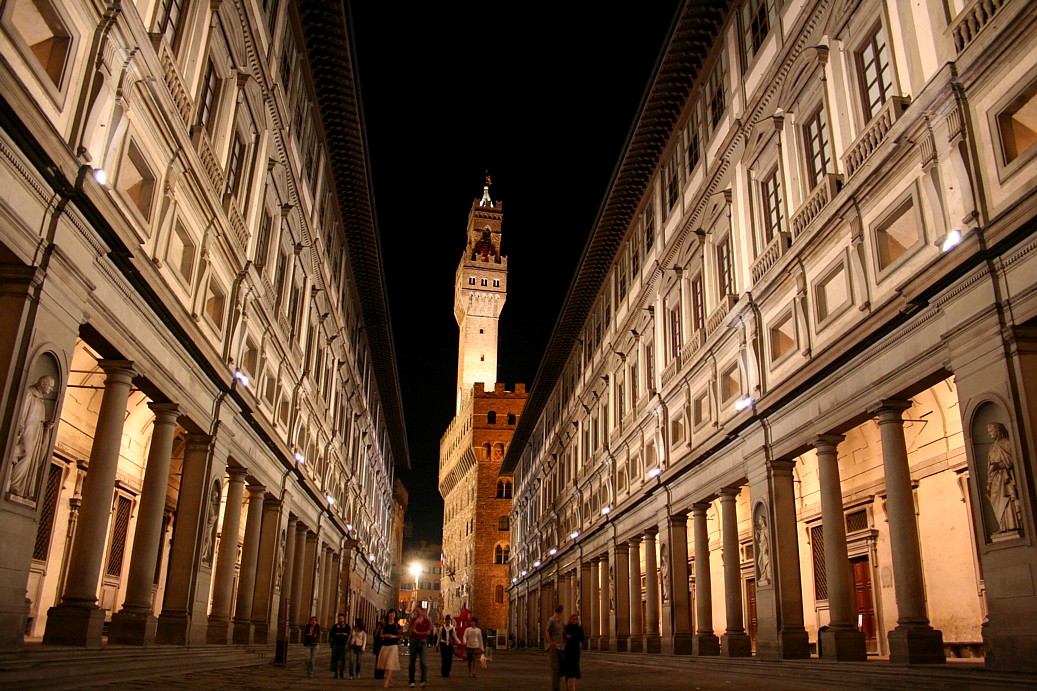
Uffizi gallery, pictures of the square

Here is Piazzale degli Uffizi, the long narrow square surruonded by the Uffizi Gallery. More infos on the Uffizi Museum are in this post :-)


.

Pictures of Palazzo Strozzi


Yesterday I went to Palazzo Strozzi to see the temporary exhibition of contemporary art that is placed in the inner court of the building.
The court is a perfect example of renaissance love for geometry, and is a wonderful frame for contemporary installations of art.
Currently Palazzo Strozzi is also hosting a very interesting exhibition dedicated to Galileo Galilei and the graphic representation of the universe from the classic era to the telescope innovation. ( for more info check the official Palazzo Strozzi Website). http://www.palazzostrozzi.org/

Here are the pictures I took yesterday in the evening!

the inner court of Palazzo Strozzi

the installation of contemporary art in the inner court of Palazzo Strozzi

facade of Palazzo Strozzi

.

Stibbert Museum and Stibbert Garden, Florence

Yesterday I went to Villa Stibbert to enjoy a walk in the park and to visit the museum... I didn't know how nice and interesting it was until my friend Daniela took me there! Thank you Dany :-)
The villa was once Stibbert's home, and has 57 rooms that exhibit all of Stibbert's collections from all around the world. Frederick Stibbert was a rich heir born in 1836 and grown in England, but lately moved to Florence. He had no need to work so he lived his life collecting objects and turned his house into a museum.

Paintings are displayed throughout every room, including still lifes and portraits. There is also collections of valuable furniture, porcelains, Tuscan crucifixes, Etruscan artifacts, and an outfit worn by Napoleon I.

Sure the most interesting exhibition is the Stibbert's Arms and Armour collection: more of 12.000 pieces of arms and armour from the 15th trough the 19th century, from all over the world: European, Oriental, Japanese, Arab pieces.

In the Cavalcade Room you can admire a large collection of medieval knights on horseback and foot-soldiers dressed with original armours and holding their weapons… that’s impressive! In the Samurai Room there are more than 80 armours and hundreds of swords.

Outside the museum, over the walls of the villa, there is a large collection of stone coats of arms from the most important nobile families from all over Europe.
The museum also contains a small cafe and a bookstore.

The garden of the villa is pretty interesting too, it’s a nice English garden full of strange things and historical quotes, as it was very popular and appreciated in the second half of 1800.
Walking around the park you can find a nice small temple in classical style, with a dome covered with coloured pieces of ceramic, some ponds, a lot of wild vegetation, an elegant “limonaia” (typical rural building used to recover citrus plants like lemons), and even an odd small neo-egyptian temple built on an island in the main pond, with sphinxes, pharaoh statues and a small obelisk.
The paths are curvy and quite wild, and are dotted with statues.
It’s a very curious garden, full of odd things that play with history, geography and cultural quotes, a perfect example of the 800esque ideas of Sublime and Beautiful, typical of Picturesque.
the classical small temple in Stibbert Garden, Florence.


a nice classical terrace in front of Stibbert villa
the limonaia of Stibbert Villa with a wonderful lemon tree in a pot

the weird neo-egyptian temple in the Stibbert Garden in Florence

.

The Vespa and Piaggio Museum (Pontedera)

This is a fantastic museum! It’s not so famous, but if you love Vespa, at least if you liked Vacanze Romane (the movie), you really have to see it, it also has free entrance!
I’ve been there some weeks ago and it really amazed me… I still have an old Piaggio moped called “Grillo” and I’m quite sentimental about it, and the Vespas are so cool!

The Vespa Museum is located in Pontedera, a small city between Florence and Pisa, where the historical Piaggio factory sis producing scooters and motorcycles since 1884.
The Piaggio Museum was inaugurated on the 29th March 2000, it occupies 3,000 sq. m. of what used to be the old company toolshop, a smart conversion of an industrial area for cultural purposes.

The Museum's halls display Vespa and Gilera collections, with the most significant of Piaggio's products.
The Vespas on display are the most beautiful and the rarest of their kind, such as the prestigious Vespa painted by Salvador Dalì or the record-breaking Vespas.
Beside the Vespa are the products that also made the history of the company, mopeds such as “Ciao” and “Sì” that marked an epoch and the multi-functional Ape, the small truck that artisans and retailers over the generations have used and appreciated for its versatility, and which had an important role in reconstructing Italy after the second world war.

I took hundreds of pictures, there are some incredible Vespas!
Here are some examples of the amazing Vespas of the Piaggio Museum that I portrayed:

Some classic Vespas, behind you can see a couple of Ape trucks

A very long Vespa!

This Vespa was painted and autographed by Salvador Dalì in 1962

This "Siluro Vespa" (that means rocket) in 1951 beated all standing kilometre records with a time of 21.4 seconds and an average speed of 171.1 km/h.

the special Vespa Alpha, designed for the movie "Get Smart"

A giant Vespa and a cow-Vespa

Vespa 150 T.A.P. a very special Vespa, produced between 1956 and 1959, used by the Foreign Legion and French paratroopers.
.

Firenze com'era Museum (Florence as it used to be)


I visited this museum during the European Heritage Day, a special day when all the museums are free for everyone.

The museum is located beside the Convento of the Oblate, accommodated in a building with a beautiful garden and a cloister. We had free entrance but usually the ticket is really cheap, only 2,70 euros.
The museum is on the ground floor of the building, and is made of two distinguished sections. The first is about the topographical museum: more than an topographical museum: it is a documented history of the representation of a city seen through the eyes of the citizens in the ages. Maps in the past were difficult to trace, obviously bird-eye photos didn’t existed yet, so it was hard to calculate exactly distances. Maps used to give not only information about the geography, but also about cities, activities, points of interest.

the cloister and garden of the museum


Here is exposed the ancient and famous Map of the Chain (“la pianta della catena”), called in that way it has a frame decorated with a chain.
It’s really not a plant… is not more a general view Florence, an axonometric projection realized at the end of 1400, and is really big, it takes the entire wall.
It’s so beautiful and painted with an incredible care for details; above all it’s a witness of how looked Florence during the renaissance: a densely inhabited large city, still with cultivations out of the town-walls, encircled from its walls studded with doors. Every single palace and church are faithfully reproduced and clearly recognizable: Palazzo Vecchio Santa Maria Novella, the Cathedral… Arno river slides and is still a city fulcrum of people and activity: you can see people on the riverside fishing, bathing, building a bridge…

the Map of the Chain ("Pianta della Catena")

Besides the Plant of the Chain the museum conserve some other ancient pieces: the keys of the doors of the city: the ones of Porta San Frediano, Porta Santo Spirito and Porta San Gallo, enormous keys with their leather bags; they were of property of a private collector, once he died the keys were given back to the city of Florence.

Others ancient maps and city representation of Florence are exposed in the museum. There are also paintings, that show various parts of the city and how they changed through the centuries. A beautiful painting that shows the public execution of Girolamo Savonarola in the Piazza della Signoria.

the keys of the doors of Florence

At the end of the room there’s also a plastic that represent the historical center of Florence how it was befor the reorgaziation made at the end of ‘800.

the plastic of the hystorical center bofore '800

In the second room of the museum are shown some archaeological artefacts found in the eighties, when piazza della Signoria had been re-pavemented: finally we can see some traces of the ancient roman Florence. The artefacts are few but interesting, and you can also find a really interesting plastic of Florence as it was in the roman age.

the plastic of Florence in the Roman Age

.

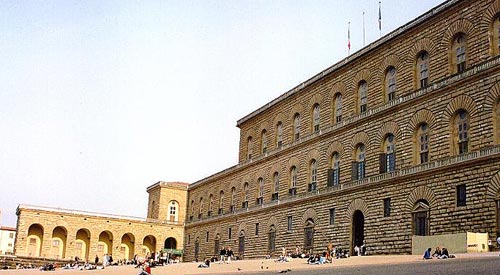
Palazzo Pitti - Pitti Palace, Florence


The gallery is second only to the Uffizi in importance, and is notable for the works of Rubens, Pietro da Cortona, Tiziano e Raffaello (Titian and Raphael).
Begun in 1458 from an original design by Brunelleschi, the architecture of Palazzo Pitti was inspired by ancient Roman buildings. An enormous affair, it was built for Luca Pitti, a one time friend of the Medici who became jealous of their power and turned against them. The palace was a blatant attempt at one-upmanship, but the fortunes of the Pitti family soon faded, and the powerful Medici family acquired the building, still uncompleted, in 1540.

It was to become the family seat in Florence and it was Cosimo´s wife, Eleanor of Toledo (whose dowry paid for the purchase), who was to transform the hillside behind the palace into the Boboli garden.


Palazzo Pitti remained the principal Medici residence until the last male Medici heir died in 1737: the Medici dynasty became extinct and the palace passed to the new Grand Dukes of Tuscany, the Austrian House of Lorraine.


The palace is home to eight separate museums: Galleria Palatina (Palatine Gallery, probably the most important one), begun by Cosimo de’ Medici the second in 1620; Gallery of Modern Art; Costume Gallery; Museo degli argenti (Silver Museum); Porcelain Museum; Boboli Garden.

Opening hours:
Open Tuesday to Sunday 8,15 – 18,50
Closed Monday, New Year’s Day, May 1st and Christmas Day.
Tickets:
Full Price: € 6,50Reduced: € 3,25
Free admission for people under 18 or over 65, students and teachers of faculties of architecture, cultural heritage conservation, educational sciences, or of Fine Arts Academy, tour guides.
.

Uffizi Museum, Florence

To see my pictures of Piazzale degli Uffizi, please read this post :-)

This is probably the most famous museum in the world. Its collection of Primitive and Renaissance paintings comprises several universally acclaimed masterpieces of all time, including works by Giotto, Simone Martini, Piero della Francesca, Fra Beato Angelico, Lippi, Botticelli, Mantegna, Correggio, Leonardo da Vinci, Raffaelo, Michelangelo and Caravaggio. The German, Dutch and Flemish masters are also present in the Uffizi museum with important paintings by Dürer, Rembrandt and Rubens.

The Uffizi Gallery is located on the upper floor of the big building planned by Giorgio Vasari from 1560, which housed the administrative offices of the Tuscan State. The Gallery was created by Francesco I, and then enriched and enlarged by other members of the Medici family, who were great collectors of paintings, sculpture and arts in general. The collection was then rearranged and enlarged by the Lorraine Grand-dukes, who succeeded the Medici family, and finally by the Italian State.

The building also houses other relevant collections: the Contini Bonacossi Collection and the Collection of Prints and Drawings (Gabinetto Disegni e Stampe degli Uffizi).The Vasari Corridor, the raised passageway connecting the Uffizi with Pitti Palace, was also built by Giorgio Vasari in 1565: the Corridor is hung with an important collection of 17th-century paintings and the famous collection of self-portraits of artists.

Tickets:
Full price 6,50 €
Reduced 3,25 €
Free admission for people under 18 or over 65, students and teachers of faculties of architecture, cultural heritage conservation, educational sciences, or of Fine Arts Academy, tour guides.

Opening hours:
Open Tuesday to Sunday 8,15 – 18,50Closed Monday, New Year’s Day, May 1st and Christmas Day.
For Booking: +39(055) 294883
Booking charge: 4 €

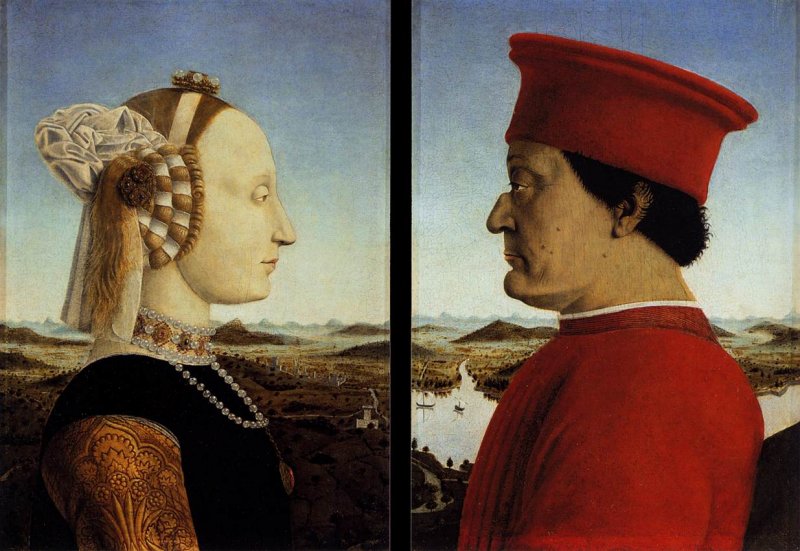
Double Portrait of Federico da Montefeltro and his wife, by Piero della Francesca
Self-Portrait, by Raphael

The Head of Medusa, by Caravaggio

The Birth of Venus, by Botticelli

Bacchus, by Caravaggio
Here are two nice videos that I found on Youtube which show the Uffizi tour :-)


.

Palazzo Strozzi, Florence


Palazzo Strozzi has been built during a long time and various architects planned it: the result is an harmonic and perfect example of reinassance palace, the most regular, homogenous and symmetrical one, in a time which the symmetry and the regularity of shapes were very appreciated gifts. This palace was the house of the Strozzi family, an important dynasty of rich florentine bankers, who built this magnificent building to demonstrate its own wealth, to use it as personal residence, but also for its own transactions and businesses.


The private house is placed on the two superior plans, while on the ground floor, around the inner court, there were shops and banks: the court was opened the public and it was shaped like a real public city square, an extension in the private space of the public city.


Externally the Palace is solid and compact: a facade in solid stone, with a “bugnato” surface with large sketched blocks, with regular windows, diversified for level: square small and to the ground floor, double lancet windows closed in an arc to the superior floors.
Even in the inner court, in the rooms and in the plant, we can see the perfect symmetry.
The inner court is just so beautiful, it’s easy to imagine it full of people busy with business in their daily lives, walking in the rooms and stepping up the big elegant stairs.


Today Strozzi Palace is an important museum with international expositions of paintings sculptures, architecture, which periodically change.
The Palace is in the historical centre of Florence, easily reachable by bus or with a 5 minutes walk from Santa Maria Novella Station.

.
Related Posts with Thumbnails