.

Ricerca personalizzata
Showing posts with label culture. Show all posts

discover Livorno!

Today I’m going to tell you about another city in Tuscany, less famous than Firenze, but really interesting from a touristic point of view: Livorno.
That’s the city where I was born! I moved to Florence when I was 20 but my family still lives in Livorno and I often go back to my beautiful natal city.
Livorno is on the coast known as the Etruscan Coast, about 90 kilometres from Firenze, from which you can easily reach by train or car in about 1 hour and half. It’s just 20 kilometres far from Pisa, and the two cities are kind of enemies from centuries.

Livorno was a small port and village until Ferdinando I de’ Medici decided to found here a new city, an ideal perfect city according to the renaissance theories. Soon Livorno became the main port of Tuscany, and people from all over the world came here: merchants, sailors, exiled and refugees for political or religious reasons. That’s because Ferdinando I enacted a law that opened up the city to everyone who wanted to live and work here, no matter their nationality, religion or if they where exiled from other countries.
Livorno became a melting pot of cultures, religions and thoughts. Jews were not contained into a ghetto, indeed they were powerful, rich and attained important political positions. Other communities living in Livorno came from Greece, Germany, France, Netherlands, England, Armenia, Eastern Europe, Asia and Muslim Countries, each one free to establish its own church, cemetery and schools. Still today the city is very opened to the difference (in culture, art, politic and society) and tolerance and respect are very important values.

The city is rich in history and architecture, as you can see from my pictures, from late renaissance to baroque, then neo-classicism and even some exquisite art nouveau buldings. The historical neighbourhood of Venezia Nuova (“New Venice”) was built in the early 1600 and is very characteristic, thanks to its water canals that surround small islands and that were used to transport goods from the port to the storehouses placed in the lower level of the palaces.
Plus there’s a beautiful long waterside with sidewalks, gardens and a wonderful terrace on the sea.
At the south edge of the city starts a wonderful panoramic road, il Romito, that runs on the top of an impressive cliff that falls down in the sea; here you can find one of the most fascinating and wild places to enjoy the sea. Not sandy beaches, but colourful rocks, crystal waters and lots of sealife to admire while snorkelling.

Don’t forget the pleasure of tasting the local cuisine, made of fresh seafood that reflects the multi-cultural influences of the city, and that is considered the best in Tuscany and one of the best in Italy. The local dishes are made with the “poor” fish, those species of fishes that could not be sold at the market and ended in the fisherman’s pan. Less noble but cheaper and super-tasty!!!

I highly recommend you to visit Livorno, discover the fascinating story of the city, enjoy the beautiful sea, and taste one of the best Italian sea cuisine!

that's my dog at Terrazza Mascagni, an amazing terrace on the sea one of the canals in Venezia Nuova the church of santa Caterina reflecting in the water surface of the canal (Venezia Nuova) la Fortezza Nuova (ancient fortress) in the Medicean port of Livorno the rocky cliffs and crystal water of Romito

.

Medici Villa of Trebbio, Mugello

This Medici villa is located in the nearbies of Florence, in the Mugello region, a wonderful corner of quiet tuscan countryside.
Villa del Trebbio is really ancient, but in 1428 Cosimo de’ Medici completely renovated and enlarged it; the architect is Michelozzo (the same of Cafaggiolo and Palazzo Medici).
This villa was surrounded by forests and agricultural estate, and even if it looks like a fortified castle, it was a place of pleasure and rest for the Medici family. Today the castle is surrounded by a beautiful cypress wood with more than one century old trees.
Unfortunately today this villa is private, and visits can be booked just in some special occasions.

You can see the tour of my daytrip in Mugello in this post!


.

my Day Trip in Mugello


Last week I decided to spend a Sunday in Mugello, a wonderful corner of tuscan countryside, rich in nature, art and history, just a few kilometres away from Florence.
Mugello was dominated by Etruscan first, then by Romans. In the middle ages was territory of the Guidi and Ubaldini families, whose fought Florence. Then from 1300 the Mugello became an important area for Florence, because of its strategic and economic importance.
Several important buildings and fortresses, castles, villas, monasteries and palaces still bear witness to this important period of growth in Mugello. In fact, even the artistic and cultural history of Florence owes much of its development to Mugello: artists such as Giotto and Beato Angelico were born here; important architects worked on the construction of the castles and moreover, the Mugello landscape has provided inspiration for numerous Florentine paintings.

I decided to follow the “Medici Route”, discovering the places where the Medici family lived nad ruled.
The tour starts in Scarperia, which was founded by the town of Florence at the beginning of the 14th century, and still conserves the impressive Palazzo dei Vicari, which was built in the same period but has undergone numerous transformations and restorations throughout the centuries. Palazzo Vicari houses the Museo dei Ferri Taglienti - antique and modern cutlery – as Scarperia is well known for knife handcrafts.
From Scarperia move to the small town of Sant’Agata, where there is a beautiful Romanesque church, the most famous sacred structure in Mugello.
Then visit the Bosco ai Frati Convent, which was built according to Michelozzo’s design, by order of Cosimo dé Medici. Inside, you find the splendid Crucifix by Donatello ( opened only on Saturday and Sunday morning because friars still live here).
Heading towards San Piero a Sieve, you find Villa Medicea of Cafaggiolo, one of the favourite residences of Lorenzo the Magnificent, and a splendid example of Renaissance architecture (visits must be booked). Not far away, towering above you, surrounded by century old cypress trees, you can admire the Trebbio Castle: another magnificent Medici construction (private, visits only in special days).

In the next post I’ll let you know all those wonderful places!


Here's a small useful map of Mugello!

.

National Library, Florence

The National Central Library of Florence is the biggest library of Italy and one of the biggest of whole Europe.

The library was founded in 1714 by Antonio Magliabechi, who donated his collection of 30,000 volumes to the city of Florence. By 1743 it was required that a copy of every work published in Tuscany be submitted to the library.
In 1861 its holdings were combined with those of the Biblioteca Palatina, and since 1870 the library has collected copies of all Italian publications.

Originally the collections were keeped in some rooms of the Uffizi Gallery, but since 1935 the library have been housed in a building designed by Cesare Bazzaniu and V. Mazzei, located along the Arno River in Santa Croce.

Unfortunately, a major flood of the Arno River in 1966 damaged nearly one-third of the library's holdings, most notably its periodicals and Palatine and Magliabechi collections. The Restoration Center was subsequently established and saved many of these priceless books. However, much work remains to be done and some items are forever lost.


.

Pictures of Palazzo Strozzi


Yesterday I went to Palazzo Strozzi to see the temporary exhibition of contemporary art that is placed in the inner court of the building.
The court is a perfect example of renaissance love for geometry, and is a wonderful frame for contemporary installations of art.
Currently Palazzo Strozzi is also hosting a very interesting exhibition dedicated to Galileo Galilei and the graphic representation of the universe from the classic era to the telescope innovation. ( for more info check the official Palazzo Strozzi Website). http://www.palazzostrozzi.org/

Here are the pictures I took yesterday in the evening!

the inner court of Palazzo Strozzi

the installation of contemporary art in the inner court of Palazzo Strozzi

facade of Palazzo Strozzi

.

ex-monastery of the Oblate, Firenze

Yesterday I went to the ex-monastery of the Oblate, a renaissance building built in first years of XIV century, and took some pictures of this wonderful place.
For centuries this building was an hospital and a monastery, then it became property of the city of Florence: it had been completely restored and two years ago it re-opened as a modern, multifunctional public library, Biblioteca delle Oblate, which is housing over 65000 books on three storeys, a huge wifi area looking over the cloister, a coffee-shop and a children’s corner.

The three-floors cloister is just wonderful, I love its quiet atmosphere, and the smell of the flowers of the big magnolia tree…
I usually come here when I want to study in a relaxing, silent open-air space.
You really have to step to the upper floor where is a beautiful renaissance style lodge with a breath-taking view of the dome of Santa Maria del Fiore, standing in front of you, just a few meters away! In this lodge there’s the coffee shop so you can have a coffee-break while admiring the dome and reading a good book or magazine.

The public library of the Oblate also organizes guided tours of the building, every Saturday from December to March at 11.15 am.
Guided tours are free and you can also book it by telephone: +39(055)2616512
Opening times of the Oblate complex: Monday - Friday, 8.30am - 6.30pm, Saturday 8.30am -1.30pm
.

David LaChapelle Exhibition in Florence

From February 28 2009 To May 06 2009 the Galleria Poggiali e Forconi in Florence will house an exhibition by David LaChapelle.
After 10 years the world-famous photographer of celebrities David LaChapelle is back in Florence with a great free exhibition of his works.
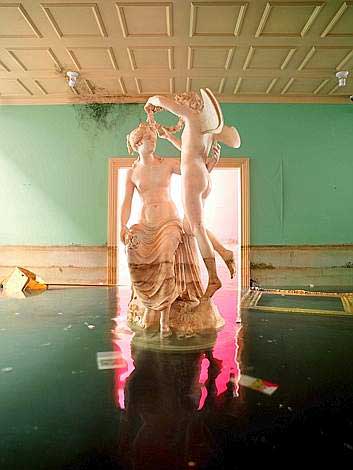
The David LaChapelle exhibition is divided into four main sections: Deluge, Recollections in America, Star System and Heaven to Hell.
This exhibition will be focused on last works of the photographer (Awakened and Recollections in America) side by side with his more famous works, as: Pietà with Courtney Love, Hi Bitch and Bye Bitch with Paris Hilton and Bon Apetite with Naomi Campbell.
Plus there’s a video of the backstage of his work Deluge.

I can’t miss this great exhibition, and entrance is even free!!!

Where: Galleria Poggiali e Forconi Via della Scala, 35/A
Project Room Via Benedetta, 3 /rosso
Florence
When: From February 28 2009 To May 06 2009
Last Through: May 6th, 2009

Opening hours: monday - saturday 9.30 am - 7.30 pm
sunday by appointment
Free entrance
.
Related Posts with Thumbnails