.

Ricerca personalizzata

Pictures of Palazzo Strozzi


Yesterday I went to Palazzo Strozzi to see the temporary exhibition of contemporary art that is placed in the inner court of the building.
The court is a perfect example of renaissance love for geometry, and is a wonderful frame for contemporary installations of art.
Currently Palazzo Strozzi is also hosting a very interesting exhibition dedicated to Galileo Galilei and the graphic representation of the universe from the classic era to the telescope innovation. ( for more info check the official Palazzo Strozzi Website). http://www.palazzostrozzi.org/

Here are the pictures I took yesterday in the evening!

the inner court of Palazzo Strozzi

the installation of contemporary art in the inner court of Palazzo Strozzi
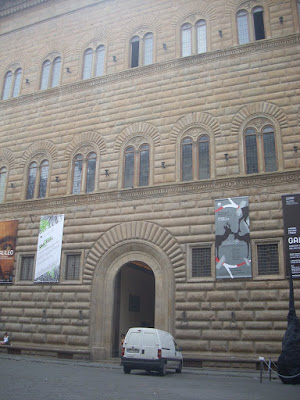
facade of Palazzo Strozzi

.

Calcio Storico Fiorentino - Historical Florentine football

Calcio Fiorentino is an early form of football that originated in 16th century in Florence, Italy. Today Calcio Fiorentino is still played in Florence. The matches used to take place in Piazza Santa Croce, and still do, every third week of June.

In this game are used both feet and hands, it’s a kind of mix between soccer, rugby and Greco-roman wrestling. Goals can be scored by throwing the ball over a designated spot on the perimeter of the field. The playing field is a giant sand pit with a goal running the width of each end.

Four historical neighbourhoods of the city, represented from their main church and a colour (Santa Croce is blue, San Giovanni is green, Santo Spirito is white, and Santa Maria Novella is red), fight against each other to win.
The modern version allows tactics such as head-butting, punching, elbowing, and choking, but forbids sucker-punching and kicks to the head.

It’s a very violent sport but also spectacular, especially because of the pre-game parade with historically accurate Renaissance costumes, and sure, for the fights!!!
If you’re going to visit Florence in late June don’t miss the Calcio Fiorentino Match!


the historical parade before the matches

fights!

the play ground in Piazza Santa Croce

.

Piazza della Repubblica, Florence


In the ancient times this square was the center of the roman city, the place where cardo and decumanus intersect. Now a column rise in this exact point to remember the past, and it’s called Colonna dell’Abbondanza (column of abundance).
From the year 1000 this square hosted the old city market.

The present appearance of Piazza della Repubblica is the result of the city planning done after the proclamation of Florence as the capital of Italy (1865-71). In this years large parts of the city centre were demolished to create the large squares and streets that a capital needed.

The decision to enlarge the square needed the destruction of several historical important buildings: medieval towers, churches, the corporate seats of the Arti, palaces, craftsmen's shops and thousand of houses.
The demolition was presented as a necessity, as the area's insanitary conditions were to be improved, but was in reality led above all to building speculation and to legitimization of the will of the emerging middle-class, protagonist in the events that bring Italy to unification.

The big arch in Piazza della Repubblica, called Arcone, remember with an inscription the huge demolition of the 19th century:

L’antico centro della città
Da secolare squallore
A vita nuova restituito

"The ancient centre of the city
restored from age-old squalor
to new life"

Colonna dell'Abbondanza, the exact place where cardo and decumanus used to meet in the roman city of Florence

the old carousel in Piazza della Repubblica

the big arch, with the commemorative inscription, called "Arcone"


the big arch of Piazza della Repubblica from the back

.

ex-monastery of the Oblate, Firenze

Yesterday I went to the ex-monastery of the Oblate, a renaissance building built in first years of XIV century, and took some pictures of this wonderful place.
For centuries this building was an hospital and a monastery, then it became property of the city of Florence: it had been completely restored and two years ago it re-opened as a modern, multifunctional public library, Biblioteca delle Oblate, which is housing over 65000 books on three storeys, a huge wifi area looking over the cloister, a coffee-shop and a children’s corner.

The three-floors cloister is just wonderful, I love its quiet atmosphere, and the smell of the flowers of the big magnolia tree…
I usually come here when I want to study in a relaxing, silent open-air space.
You really have to step to the upper floor where is a beautiful renaissance style lodge with a breath-taking view of the dome of Santa Maria del Fiore, standing in front of you, just a few meters away! In this lodge there’s the coffee shop so you can have a coffee-break while admiring the dome and reading a good book or magazine.

The public library of the Oblate also organizes guided tours of the building, every Saturday from December to March at 11.15 am.
Guided tours are free and you can also book it by telephone: +39(055)2616512
Opening times of the Oblate complex: Monday - Friday, 8.30am - 6.30pm, Saturday 8.30am -1.30pm
.

Santa Maria Novella: a walk in the cloister

I took those pictures some days ago, in a bright morning. I just went out for a walk and decided to enter in the cloister of Santa Maria Novella. I've been there so many times and it's always a pleasure...
Is a little peaceful place, with beautiful arches and leafy tall trees, the perfect quiet corner to take a rest and relax.

From the cloister you can enter into the church of Santa Maria Novella paying a ticket (2 euro) or enter in a small chapel where you can pray without paying the ticket (but also without seeing the wonderful church from the inside!).

the external of the cloister, with a nice violin player

the access to the cloister is in the arch beside the facade of Santa Maria Novella


.
Related Posts with Thumbnails