.

Ricerca personalizzata

Markets of Florence

What about spending some time hanging around the stalls of a market to breathe the genuine atmosphere of a city?
In Florence there are a lot of markets where you can buy almost everything; here is a list of the main markets, the ones that are strongly recommended if you’re planning to visit the city.
Florence is famous for leather products, and sure for meat, cheese and food in general; you can find all those things at the market at very reasonable prices.

Market of San Lorenzo
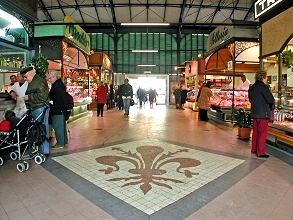
In front of the church of san Lorenzo, in piazza San Lorenzo and via dell’Ariento, this is the main market of the city. Outside you can find clothing, leather shoes, belts, bags, souvenirs, and more. Inside de building there are the food stalls, selling meat, vegetables, fruit, cheeses… Always very crowded.
Opened from Tuesday to Saturday, externally all day long, inside from 7 to 14.


Market of Sant’Ambrogio
In piazza Sant’Ambrogio, this is the right place if you’re looking for the best food at the best price in Florence! Less crowded than San Lorenzo, here you find less tourists and more locals; in this market there is also the restaurant Rocco, where you can stop for a tasty traditional Tuscany lunch. Outside the market some stalls sells clothing, house ware, books, dvds, and more.
Opened every day except Sunday, from 7 to 14.

Le Cascine Market
In the biggest park of the city, Le Cascine, on the Arno riverside, every Tuesday morning a very big market takes place: food, clothing, house and kitchen ware, collectibles, vintage stuff, you can find almost everything here! Don’t forget to take a walk in the park after shopping ;-)

Flea Market- Piazza dei Ciompi
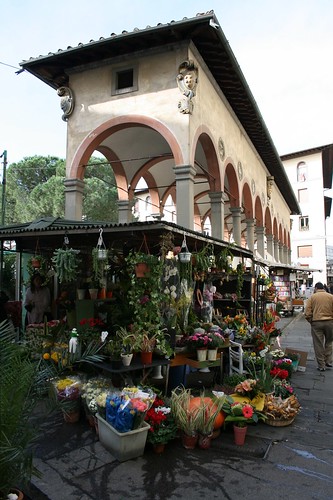
In Piazza dei Ciompi, opened every day except Sunday, from 9 to 19, there’s the flea market of Florence. The stalls sell furniture, books, comics, records, prints, paintings collectibles, jewels, old coins and much more. This market is really charming, with its retro atmosphere!
.

Palazzo Strozzi, Florence


Palazzo Strozzi has been built during a long time and various architects planned it: the result is an harmonic and perfect example of reinassance palace, the most regular, homogenous and symmetrical one, in a time which the symmetry and the regularity of shapes were very appreciated gifts. This palace was the house of the Strozzi family, an important dynasty of rich florentine bankers, who built this magnificent building to demonstrate its own wealth, to use it as personal residence, but also for its own transactions and businesses.


The private house is placed on the two superior plans, while on the ground floor, around the inner court, there were shops and banks: the court was opened the public and it was shaped like a real public city square, an extension in the private space of the public city.


Externally the Palace is solid and compact: a facade in solid stone, with a “bugnato” surface with large sketched blocks, with regular windows, diversified for level: square small and to the ground floor, double lancet windows closed in an arc to the superior floors.
Even in the inner court, in the rooms and in the plant, we can see the perfect symmetry.
The inner court is just so beautiful, it’s easy to imagine it full of people busy with business in their daily lives, walking in the rooms and stepping up the big elegant stairs.


Today Strozzi Palace is an important museum with international expositions of paintings sculptures, architecture, which periodically change.
The Palace is in the historical centre of Florence, easily reachable by bus or with a 5 minutes walk from Santa Maria Novella Station.

.

Tuscany Recipe: Summer Farro Salad - Emmer Salad

A fresh tuscany recipe, perfect for summer, easy to prepare and still tasty the day after :-)
This is the basic original recipe, but you can add other ingredients: peppers, olives, zucchine...


Ingredients:
500 gr of emmer (farro)
500 gr of ripe red tomatoes
2 onions
a bunch of basil
extravirgin olive oil
salt
black pepper

Preparation:
Wash emmer, than put it in a big pan and fill with water. Add 2 spoons of salt and make it boil: then cook for 30 minutes (or as specified in the instructions on the pack).
Chop tomatoes and onions into small pieces, then chop the asil with your hands. Put everything in a big bowl, add the emmer.
Season with oil, salt and pepper to your choice, mix and refigerate before serving.
.

Florence recipe: Panzanella

This is a fresh, tasty, summer recipe: a bread salad, very easy to cook, and it can be prepared even a couple of days before is eaten ;-)
I love the panzanella, it's so delicious and it's a perfect cold meal that I can carry at work or when I travel...
It's a tipical Florence dish, but it's very popular in the whole Tuscany.


Ingredients:
400 g of day-old country bread (best one is tuscany unsalty bread)
8 red, ripe tomatoes
2 red onions
1 cucumber
a bunch of fresh basil
extra-virgin olive oil
red-wine vinegar
salt
pepper


Preparation:

Cut the bread into 1-inch cubes, then place the cubes in a bowl with water; squeeze them with your hands, put in a large bowl, and crumble it with your fingers.

Cut the cucumber and tomatoes into small pieces, cut the onions into thin slices, then add all to the bread.

Chop the basil and add to the bread, then season with oil, vinegar, salt and pepper. Mix gently and place in the frige until serve.
.

Museo dell'Opificio delle Pietre Dure - Museum of Semiprecious Stones Factory


The Museum is located in via degli Alfani, right behind the Accademia Museum (you'll easily recognize it from people waiting in line outside). In this museum there's never to wait in line, it's quite unknow to most people, but it sure deserve a visit.
This museum collects some wonderful objects originally made in the Opificio delle Pietre Dure, a 400 years old handcraft laboratory, founded by Ferdinando I and originally located in the Uffizi museum. Nowadays the Opificio is an important restauration laboratory, and the museum tells us the story of this great and still unknown italian art.

The building of the museum is pretty ancient, and it was restored in a modern but sober and elegant way by prof. arch. Natalini.
The exposition collects beautiful objects made with semiprecius stones of every kind, realised with several different techiques:: inlay, painting, sculpture...

The hands that have worked on stones were so skillful, they have realized designs full of details, colors and complex forms, cutting accurately thousands of stone slabs and assembled them together in order to create inlays of absolute perfection. Flowers, leaves, animals, dead natures, represented on every type of object: tables, fireplaces, tobacco cases, pots, church furnishingses. The colors are thousands, as much as the stone varieties, fine cut and joined, with their tonalities and texture that give an incredible three-dimensional effect.

Tables are sure the more numerous objects and are just amazing: generally they have a black polished stone plan, on which have been realized the inlay or painting designs; some are realized with mixed techniques. Stones create some spectacular effects: a brown stone, streaked as a wood table becomes a violin; a pink stone that vanishes in orange becomes a peach, a red diaspro becomes a complicated coral branch… they have been realized with an incredible handicraft precision, the details are perfect, I assure that it gives just a three-dimensional effect to you, and is amazing how the choice of the right stone can reproduce exactly the color and the texture of another material.


Besides the plans of the tables the objects I appreciated most are: a majestic enormous Russian fireplace, entirely realized in green emerald diaspro and copper, and one wooden piece of furnture with several trays, mad in 1600, really amazing: in the form it imitates a rinaissance palace of Firenze, every little tray is decorated with a stone slab representing an exotic bird... Really a wonderful object, it would be perfect in my room!


At ground floor there's the exposure of the objects exited from the warehouses of the factory, while on the first floor there's a small section dedicated to the factory: it collects several ancient instruments for working and cutting hard stones, and a rich collection of stone samples used in the objects: marbles of every color, quartzes, basalts, graniti…

I really love this museum, and sure suggest you to visit, the entrance is very cheap (just 2 euro), but for students is free.
Inside the museum pictures are not allowed.

Opificio delle Pietre Dure
Via Alfani, 78 - 50121 Firenze (Italy)
tel: +39 055 26511
fax: +39 055 287123
Monday - Saturday: 8.15-14.00
Thursday: 8.15-19.00
email: opd@beniculturali.it

an amazing table decorated with birds, flowers and fruits


an example of the decorations in semiprecious stones

.
Related Posts with Thumbnails